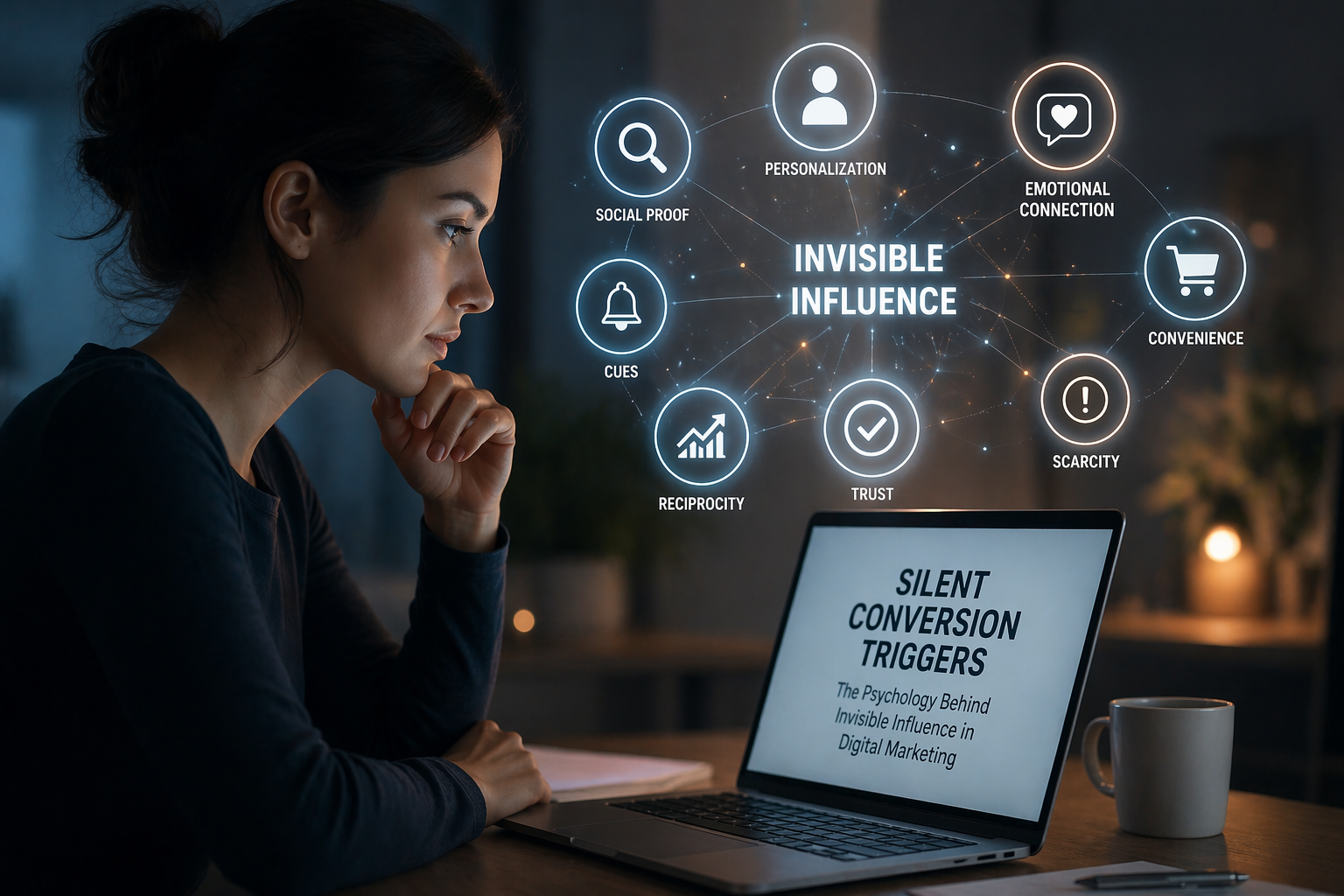
In digital marketing, not every conversion is the result of a loud call-to-action, aggressive remarketing, or flashy promotional banner.
In fact, some of the most powerful conversions happen quietly—almost invisibly.
These are driven by what can be called silent conversion triggers: subtle psychological, design, and behavioral cues that influence users to take action without feeling pushed.
Unlike traditional marketing tactics that rely on urgency or persuasion, silent conversion triggers work beneath conscious awareness.
They shape perception, reduce friction, and build trust in ways users often don’t explicitly notice—but still respond to.
I once worked with an e-commerce skincare brand that struggled with abandoned carts.
They had strong traffic, good engagement, and competitive pricing—but conversions were inconsistent.
Instead of adding more ads or discounts, we focused on micro-experience improvements: layout spacing, trust signals near product images, simplified wording, and subtle reassurance cues at checkout.
Within weeks, conversion rates improved significantly—without changing the product or pricing. The difference came from how users felt while interacting, not what they were explicitly told.
That is the essence of silent conversion triggers: they don’t demand action—they make action feel natural.
Why Silent Conversion Triggers Work
Human decision-making is rarely fully rational. Most digital interactions are guided by cognitive shortcuts, emotional responses, and subconscious trust signals.
Silent conversion triggers work because:
- The brain prefers simplicity: Less cognitive effort leads to faster decisions.
- Trust is emotional before it is logical: Users decide “safe or unsafe” within seconds.
- Friction kills conversions: Even small hesitation reduces action rates.
- Perception shapes reality: How something feels matters as much as what it is.
- Most decisions are unconscious: Users often justify decisions after taking action.
In short, users don’t always “decide” to convert—they are often guided into it through experience design.
Key Types of Silent Conversion Triggers
1. Visual Hierarchy Control
Where the eye goes first determines what the brain values most.
Subtle spacing, contrast, and layout positioning influence decisions without explicit instruction.
2. Cognitive Ease Design
Simple language, clean interfaces, and predictable navigation reduce mental effort—making conversion feel effortless.
3. Social Proof Placement
Reviews, ratings, and testimonials placed strategically near decision points reduce doubt without needing persuasion.
4. Microcopy Psychology
Small text elements like “No credit card required” or “Cancel anytime” remove hidden fears that block action.
5. Color and Emotional Signaling
Colors influence perception: trust, urgency, calmness, or excitement—all without words.
6. Default Bias
Pre-selected options (like subscriptions or preferences) gently guide user behavior without forcing it.
How Silent Conversion Triggers Shape User Behavior
Instead of asking users to take action, silent triggers remove resistance to action.
For example:
- A checkout page that feels clutter-free reduces hesitation
- A product page with clear spacing increases perceived product value
- A subtle trust badge near payment fields reduces anxiety
- A well-placed “free trial” mention reduces commitment fear
None of these explicitly persuade—but together they create a frictionless psychological path to conversion.
Case Study: Increasing Conversions Without Aggressive Marketing
A SaaS platform offering productivity tools was struggling with free trial sign-ups. Their landing page had strong messaging but low conversion rates.
Instead of changing ads or offers, we implemented silent conversion improvements:
- Simplified headline structure for faster comprehension
- Added trust indicators near the signup button
- Reduced form fields from 6 to 3
- Introduced subtle progress cues during signup
- Used calmer color tones to reduce visual pressure
Results:
- Signup conversion rate increased by 41%
- Bounce rate dropped significantly
- Users reported feeling “less overwhelmed” during onboarding
The most interesting insight was that users didn’t say the product changed—but their experience of it did.
Why Silent Triggers Are More Powerful Than Aggressive Marketing
Aggressive marketing asks users to act. Silent triggers make action feel like the easiest choice.
- Aggressive marketing creates resistance
- Silent triggers reduce decision friction
- Aggressive tactics interrupt behavior
- Silent design integrates with behavior
In modern digital ecosystems, users are increasingly resistant to overt persuasion. They scroll past ads, ignore pop-ups, and block interruptions. But they still respond to well-designed experiences that feel natural and intuitive.
Metrics to Measure Silent Conversion Impact
Because silent triggers are subtle, their impact is measured indirectly:
- Conversion Rate: Overall improvement in completed actions
- Bounce Rate: Reduction in early exits
- Time to Conversion: Faster decision-making cycles
- Click Behavior Flow: How users navigate before converting
- Drop-off Points: Where friction has been reduced
These metrics reveal whether users are moving smoothly or struggling through the experience.
Timeless Principles of Silent Conversion Design
- Less effort = more conversion
- Trust must be felt, not explained
- Design is persuasion without words
- Friction is the enemy of action
- Subtlety outperforms aggression in modern UX
Silent conversion is not manipulation—it is alignment with natural human behavior.
Reflection: Silent Influence Across Time
As digital users become more experienced, they become more resistant to direct persuasion. Ads are skipped, sales language is ignored, and aggressive funnels lose effectiveness.
But silent influence will always remain powerful because it aligns with how humans naturally think: fast, emotional, and intuitive first—logical second.
In the future, the most successful brands will not be the ones that shout the loudest, but the ones that design the quietest, smoothest, and most intuitive experiences.
Closing Thought
Silent conversion triggers remind us that in digital marketing, influence is not always visible. Sometimes, the most powerful marketing does not ask users to act—it simply removes everything that stops them from acting.
In a world of noise, the quietest experiences often convert the best.