
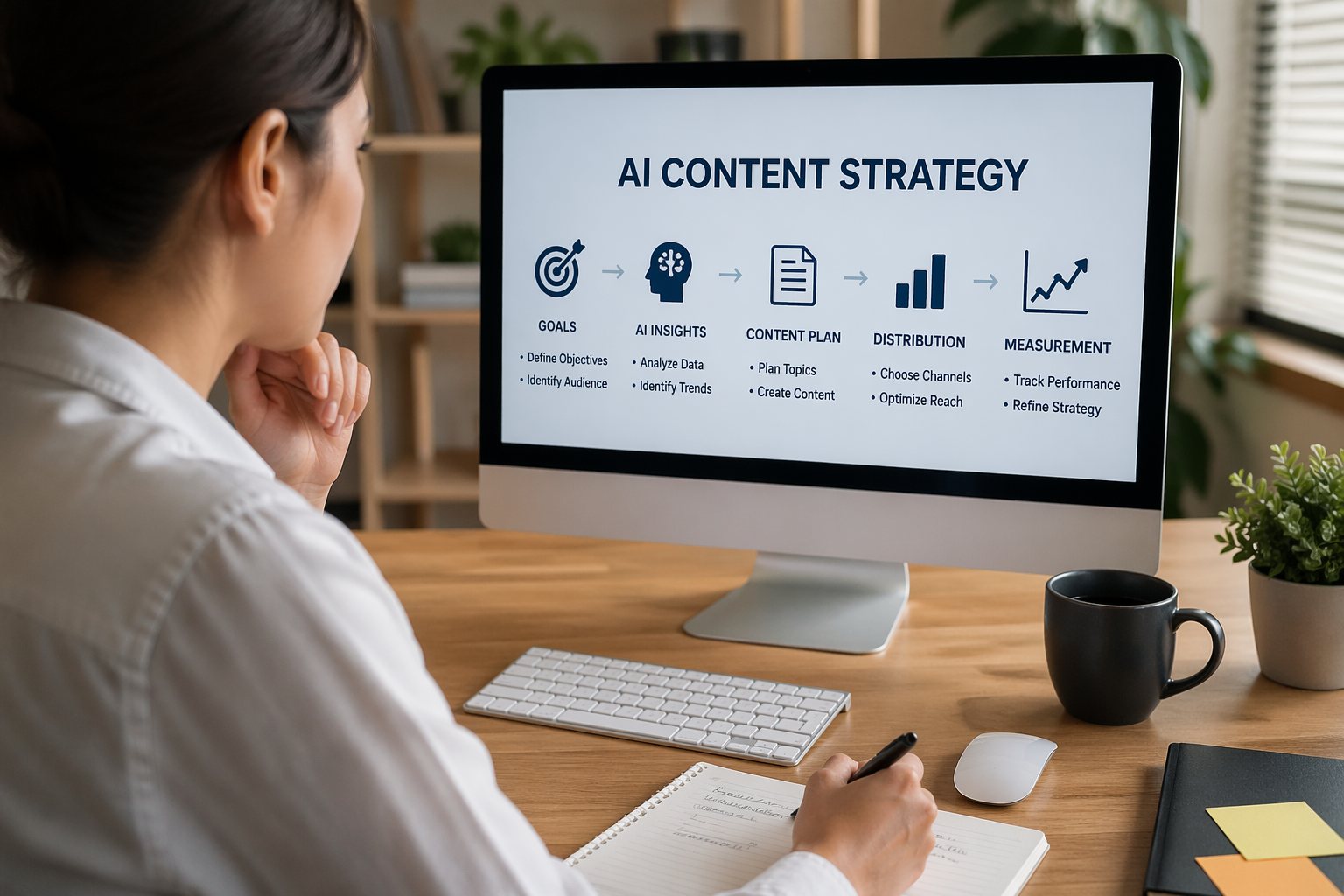
Artificial intelligence is no longer a futuristic concept in digital marketing—it is now a core production layer.
From ideation to distribution, AI is reshaping how brands create, optimize, and scale content.
But while many marketers rush to use AI for speed, the real advantage lies in building a structured AI content strategy that balances automation with human creativity.
AI does not replace content marketing—it amplifies it.
The brands that succeed are not the ones using AI to produce more content, but the ones using it to produce better, more strategic, and more consistent content at scale.
I once worked with a digital agency that struggled to maintain content output for multiple clients.
Writers were overwhelmed, deadlines were tight, and consistency varied. After introducing an AI-assisted workflow—used for research, outlines, topic clustering, and optimization—they were able to triple their content output while improving overall SEO performance.
Importantly, human editors remained in control of tone, accuracy, and storytelling. The result was not automation replacing people, but augmentation improving performance.
This is the true essence of AI in content marketing: scaling intelligence, not just output.
Why AI Content Strategy Matters
AI content strategy is becoming essential because digital ecosystems are evolving rapidly:
- Content Saturation: Millions of pieces of content are published daily—standing out requires strategy, not volume alone.
- Speed Expectations: Audiences and algorithms reward fresh, consistent publishing.
- Personalization Demand: Users expect content tailored to their needs and behavior.
- SEO Complexity: Search engines now evaluate intent, depth, and relevance—not just keywords.
- Resource Constraints: Businesses need scalable systems without exponentially increasing costs.
AI helps solve all of these challenges by making content faster, smarter, and more adaptive.
Core Pillars of AI Content Strategy
- Ideation and Topic Discovery
AI tools can analyze trends, search patterns, and competitor content to identify high-potential topics. - Content Structuring
AI assists in building outlines, logical flow, and SEO-friendly structures. - Draft Generation
First drafts can be created quickly, allowing humans to refine rather than start from scratch. - Optimization
AI helps improve readability, keyword placement, and semantic relevance. - Distribution Intelligence
Content can be adapted for blogs, social media, email, and ads automatically.
How AI Enhances the Content Workflow
A modern AI-driven content pipeline typically looks like this:
- Research Phase: AI analyzes trends, keywords, and audience intent
- Planning Phase: Topic clusters and content calendars are generated
- Creation Phase: Drafts are produced and refined with human oversight
- Optimization Phase: SEO, tone, and structure are improved using AI suggestions
- Distribution Phase: Content is repurposed across multiple channels
This creates a system where content is not created in isolation but as part of a connected ecosystem.
Strategies for Building an AI Content System
- Start with Clear Brand Guidelines
AI must operate within defined tone, style, and messaging boundaries. - Use AI for Structure, Not Final Voice
Let AI handle frameworks while humans refine storytelling and emotion. - Focus on Content Clusters
Instead of isolated posts, build interconnected topic ecosystems. - Repurpose Everything
One blog post can become social posts, email sequences, and video scripts. - Maintain Human Oversight
Accuracy, ethics, and emotional depth must remain human-driven. - Optimize Continuously
Use performance data to refine future AI-generated outputs.
Case Study: Scaling Content with AI
A performance marketing agency managing multiple clients struggled with inconsistent publishing schedules and high production costs.
We implemented an AI-assisted content strategy:
- AI generated weekly topic clusters based on industry trends
- Writers used AI-generated outlines to speed up drafting
- Editors refined tone and added brand-specific storytelling
- Content was automatically repurposed into multiple formats
Results:
- Content output increased by 3x
- SEO rankings improved due to consistent publishing
- Engagement rates rose as content became more structured and relevant
- Production costs decreased significantly
This demonstrated that AI does not reduce quality when used correctly—it improves consistency and scalability.
Metrics to Measure AI Content Strategy Success
To evaluate effectiveness, track:
- Content Output Volume: Number of high-quality pieces produced
- Organic Traffic Growth: SEO impact of AI-assisted content
- Engagement Rate: Time on page, shares, and interactions
- Conversion Rate: Leads or sales generated from content
- Content Efficiency: Time and cost per article produced
These metrics show whether AI is driving efficiency and performance together.
Timeless Principles of AI Content Marketing
- Human Creativity is Irreplaceable: AI supports creativity; it does not replace it.
- Quality Over Quantity Still Wins: More content is not better content.
- Strategy Comes First: AI is a tool, not a strategy itself.
- Consistency Builds Authority: Regular, structured content strengthens brand trust.
- Adaptability is Essential: AI models and tools will evolve—strategies must evolve with them.
The strongest content systems combine machine efficiency with human insight.
Reflection: AI Content Across Time
As AI continues to evolve, content creation will become faster, more intelligent, and more personalized.
But the fundamental principle will remain unchanged: audiences connect with clarity, relevance, and authenticity.
AI will not eliminate the need for marketers—it will elevate those who know how to use it strategically.
The future belongs to brands that can combine data-driven intelligence with human storytelling.
Closing Thought
AI content strategy is not about replacing writers—it is about empowering them to operate at scale with greater precision and impact.
It transforms content marketing from a manual, time-consuming process into a systematic, intelligent, and scalable engine of growth.
In the digital age, success belongs to those who don’t just create content—but those who create systems that continuously create better content.