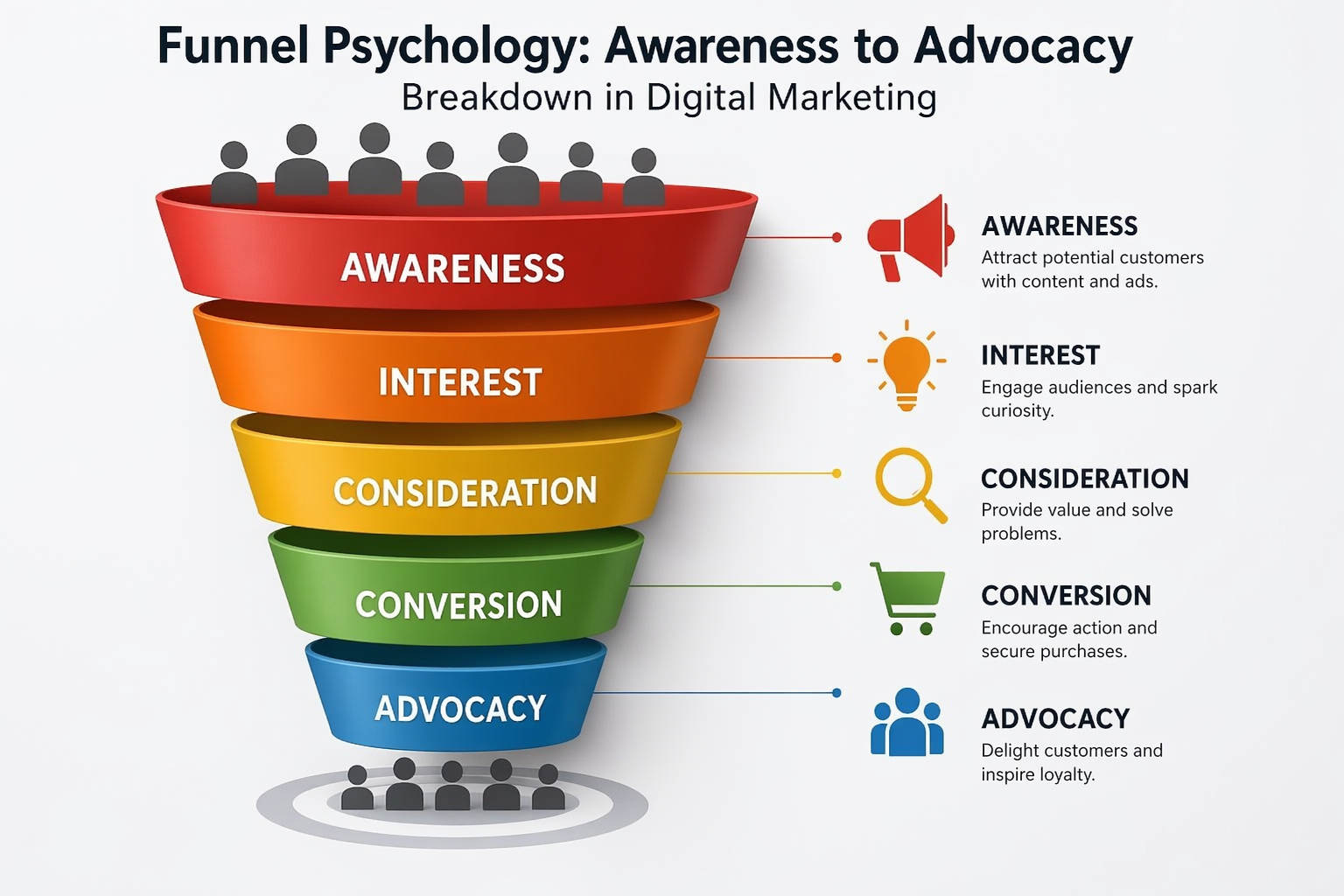
In digital marketing, a “funnel” is often described as a structured path that moves a user from discovery to purchase.
But in reality, modern funnels are not rigid systems—they are fluid psychological journeys shaped by attention, trust, emotion, and timing.
Users do not move neatly from one stage to another.
They loop, pause, abandon, return, compare, and sometimes convert without ever completing a traditional sequence.
This is why understanding funnel psychology is more important than memorizing funnel stages.
At its core, a marketing funnel is not just a business model—it is a behavioral map of human decision-making under digital influence.
I once worked with a D2C fashion brand that believed their funnel was “broken” because users were not moving smoothly from ads → product page → cart → checkout.
But when we analyzed user behavior deeply, we discovered something different: customers were entering the funnel at multiple points, often skipping stages entirely, and converting after repeated exposure across channels.
The funnel wasn’t broken—it was non-linear.
Once we shifted strategy from rigid funnel thinking to behavioral funnel optimization, conversions improved, remarketing became smarter, and content strategy became more aligned with real user behavior.
That is the shift modern marketing demands: from linear funnels to psychological ecosystems.
Why Funnel Thinking Still Matters (But Needs Evolution)
Funnels are still useful—but only when understood as mental models, not strict pathways.
They help marketers:
- Understand customer intent progression
- Structure content and campaigns logically
- Identify drop-off points in the journey
- Optimize messaging based on awareness levels
- Align marketing, sales, and retention strategies
But they fail when treated as rigid rules because real users behave unpredictably.
The Modern Funnel Stages (Psychological Interpretation)
Instead of traditional AIDA-style funnels, modern digital behavior can be understood through psychological stages:
1. Awareness: “I notice something relevant”
This is not just exposure—it is attention capture.
At this stage:
- Users are not actively searching
- Content competes with distraction
- Emotional relevance matters more than logic
Winning strategy:
Stop interrupting—start attracting. Use storytelling, hooks, and pattern interruption.
2. Curiosity: “This might be useful for me”
Here, users begin passive exploration.
They:
- Click content
- Scroll deeper
- Compare lightly
Winning strategy:
Create clarity and intrigue without overwhelming detail.
3. Consideration: “I might choose this”
This is where logic enters the journey.
Users:
- Compare alternatives
- Read reviews
- Evaluate pricing and trust
Winning strategy:
Reduce friction, increase proof, and simplify decision-making.
4. Intent: “I am close to deciding”
At this stage, users are emotionally ready but need reassurance.
They:
- Add to cart
- Start sign-up flows
- Check final details
Winning strategy:
Remove hesitation triggers: trust signals, guarantees, clarity.
5. Conversion: “I decided”
This is the action point—but not the end.
Conversion happens when:
- Emotional trust + logical clarity align
- Friction is minimal
- Decision feels safe
6. Retention: “I continue using this”
Many marketers ignore this stage, but it is critical.
Users:
- Evaluate experience
- Decide whether to return
- Form habits
Winning strategy:
Onboarding, personalization, and continuous value delivery.
7. Advocacy: “I recommend this”
This is the most powerful stage in the funnel.
Users:
- Share experiences
- Leave reviews
- Influence others
Winning strategy:
Create emotional satisfaction and identity alignment.
Why Funnels Fail in Real Digital Behavior
Funnels break down because:
- Users don’t follow linear paths
- Multiple touchpoints happen before conversion
- Decisions are delayed and revisited
- External influences (social, reviews, peers) intervene
- Attention spans shift constantly
A user might:
- Discover a brand on Instagram
- Ignore it
- See it again on YouTube
- Search it on Google days later
- Convert via a retargeting ad
No single “funnel path” explains this journey—but psychology does.
Case Study: Fixing a Broken Funnel with Behavioral Mapping
A SaaS product had strong traffic but low conversions. Their funnel looked fine on paper:
Ads → Landing Page → Free Trial → Paid Plan
But behavior told a different story:
- Users visited 2–3 times before signing up
- Most conversions came after email reminders
- Social proof influenced decisions more than landing pages
We redesigned the funnel into a multi-touch behavioral system:
- Retargeting ads based on engagement depth
- Email sequences triggered by micro-actions
- Content designed for repeated exposure, not single conversion
- Testimonials placed across multiple touchpoints
Result:
- Trial sign-ups increased
- Conversion lag reduced
- Customer acquisition became more predictable
The funnel didn’t change structurally—the understanding of behavior changed.
Key Metrics for Modern Funnel Analysis
Instead of only tracking linear conversion rates, modern funnel thinking includes:
- Multi-touch attribution paths
- Engagement depth per stage
- Return visitor conversion rate
- Assisted conversions
- Time-to-decision metrics
- Micro-conversion tracking
These reveal how users actually move—not how we assume they move.
Timeless Principles of Funnel Psychology
- Funnels are mental models, not user instructions
- Trust matters more than structure
- Repetition builds familiarity, familiarity builds conversion
- Users convert when emotion and logic align
- The journey is rarely linear—but always behavioral
Final Reflection: Funnels Are Dead—But Funnel Thinking Isn’t
The traditional funnel is too simplistic for today’s digital environment. But the idea behind it—understanding how users move from awareness to action—is still essential.
Modern marketing is not about forcing users through stages. It is about understanding psychological states and designing experiences that adapt to them.
In the future, the most successful brands will not optimize funnels—they will optimize human behavior across fragmented, multi-touch journeys.
Closing Thought
Funnel psychology teaches one powerful truth:
People don’t move through systems—systems must adapt to people.
When you stop forcing linear journeys and start designing for real behavior, marketing stops feeling like a funnel—and starts functioning like a living decision ecosystem.